Feynman Technique for Studying: Master Complex Topics Fast
Here’s an uncomfortable truth: your brain might be actively working against your most common study habits.
#Why Your Brain Isn't Wired for Traditional Study Methods
Here’s an uncomfortable truth: your brain might be actively working against your most common study habits. When you spend hours highlighting passages and rereading notes, your mind creates a dangerous illusion of knowledge. This feeling of familiarity is often mistaken for genuine understanding, a facade that crumbles the moment you need to apply what you've "learned"—like during an exam or on a project. This happens because passive methods like rereading don't force your brain to do the heavy lifting required for true learning.
#The Trap of Passive Familiarity
Think about the last time you reread a textbook chapter. It probably felt productive, right? The text becomes more familiar, key terms look recognizable, and you start to believe you've got it down. However, cognitive research shows this is often just surface-level recognition, not deep comprehension. Your brain is a master of efficiency; it prefers shortcuts. Recognizing something is far less energy-intensive than truly understanding and reconstructing it from memory. This is the memorization trap that keeps so many bright students struggling. They can recite definitions but can't solve a new problem because the underlying concepts were never truly cemented.
This disconnect is precisely why explanation-based learning is so powerful. Instead of passively consuming information, these strategies force you to actively build knowledge structures from the ground up. When you explain a concept in your own simple words, you aren't just recognizing it—you're recreating it. A 2021 study involving 10,000 global users found that those who consistently used the Feynman Technique for studying scored an average of 22% higher on knowledge retention tests compared to peers using traditional memorization. You can dig into these findings on Ali Abdaal's platform.
#From Recognition to Reconstruction
The difference between recognition and reconstruction is critical. It’s like the difference between recognizing a city's skyline in a picture versus being able to draw a map of its streets from memory. Traditional study methods teach you to recognize the skyline. An active approach like the Feynman Technique gives you the mental map. This is why a new approach is needed—one that actually works with how our brains build lasting knowledge. By understanding why passive learning fails, you can see why active, explanation-based strategies are not just another study hack, but a fundamental shift in how you should approach learning itself.
#The Science Behind Teaching to Learn
Richard Feynman, the Nobel-winning physicist, wasn't just a brilliant mind; he was a master of deep understanding. He figured out that true knowledge isn't about memorizing jargon but about making tough ideas feel simple. The Feynman Technique for studying is built entirely on this principle. It’s not about dumbing things down but about knowing a subject so well you can explain it with absolute clarity. The whole method hinges on the psychological power of teaching.
#Why Explaining Cements Knowledge
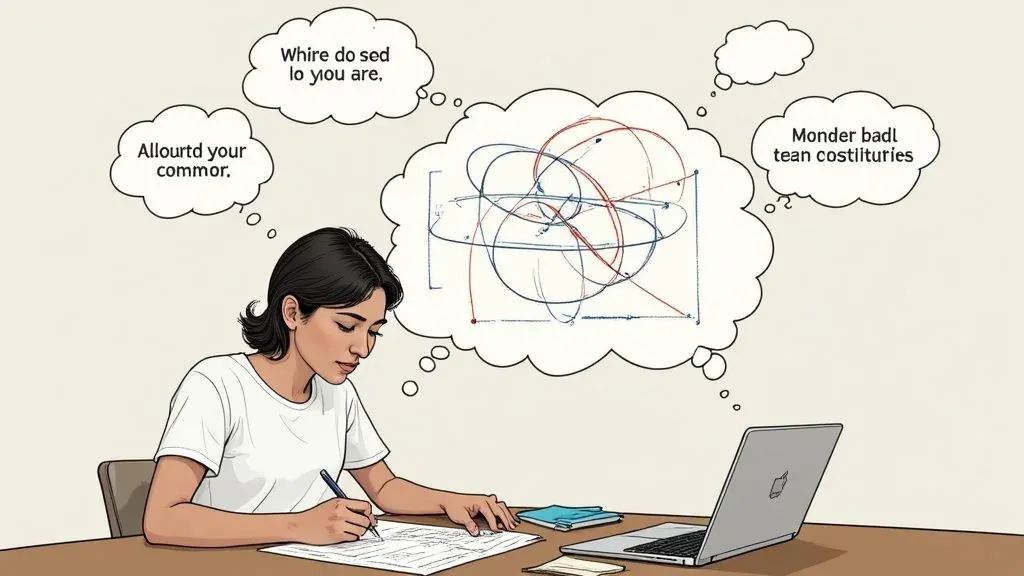
When you try to explain something to another person—or even just to yourself—you kick your brain into a process called active knowledge reconstruction. This is way more effective than just rereading your notes, which lets your brain get lazy with simple pattern recognition. Teaching forces you to do more:
- Retrieve information from your memory, not just spot it on the page.
- Organize scattered facts into a story that makes sense.
- Identify the real connections between different parts of the topic.
This active effort instantly shines a light on the weak spots and gaps in your understanding. You might feel confident about photosynthesis, but try explaining it to a 12-year-old. Suddenly, you're fumbling over the details of chlorophyll or the Calvin cycle. Those moments where you get stuck are pure gold—they show you exactly what you need to work on. This is the difference between flimsy familiarity and rock-solid, long-term knowledge.
#From Academic Struggles to a Powerful Method
Feynman came up with this method during his own time at Princeton. He found that by breaking down dense physics papers and rebuilding them in his own simple words, he could master the material on a fundamental level. This technique works for any subject you can think of, from biology to history, because it taps into how our brains build and strengthen connections. You can dive deeper into the nuts and bolts of the method in our guide on what the Feynman Technique is and how to master complex concepts fast.
Modern results back up this idea of active reconstruction. A 2020 survey from the University of Colorado’s Academic Advising and Coaching center revealed that over 35% of students who used the Feynman Technique saw noticeable improvements in their exam scores. On average, their grades went up by 10-15% in just one semester. You can find more details about the Feynman Technique in academic coaching and how it helps create this deeper learning. By turning your study notes from passive records into active teaching scripts, you stop being just a consumer of information and become a creator of knowledge. That’s the real secret to making it stick.
#Your Four-Phase Learning Transformation
Let's get practical. The real strength of the Feynman Technique for studying comes from its four-phase process that takes you from just recognizing a term to actually understanding it. This method works wonders whether you're trying to grasp organic chemistry reactions or the complexities of medieval European history. Each phase logically follows the one before, systematically showing you what you don’t know so you can address it.
#Choose Your Concept and Explain It
To start, pick a single idea you want to learn. Resist the urge to tackle a whole textbook chapter at once. Instead, focus on one core concept, like "nucleophilic substitution" or "feudalism." Find a blank sheet of paper, a whiteboard, or a new digital note. Write the concept's name at the top.
Now, explain everything you know about it as if you were teaching someone else. The crucial part is to use your own words, not just copy definitions from your notes. For instance, if you're studying feudalism, avoid simply writing "a social system in medieval Europe." Try to explain the relationships: "So, the king owned all the land, but he couldn't manage it himself. He granted big pieces of it, called fiefs, to powerful nobles. In exchange, these nobles had to give him knights for his army." This simple act of writing forces you to engage with the topic directly.
#Simplify, Simplify, Simplify
This is where you find out what you really know. Read your explanation out loud. Does it sound confusing or clunky? Are you leaning on technical terms you can't easily define? Your mission is to simplify the concept so a curious 12-year-old could understand it. This pushes you to break down complex ideas into their basic parts and come up with analogies that connect abstract thoughts to concrete examples.
For example, when explaining nucleophilic substitution, you might use an analogy like someone cutting in on a dancing couple. The new partner (the nucleophile) steps in and replaces one of the original dancers (the leaving group).
This act of simplifying helps you write the concept in plain English, use helpful comparisons, and mark areas that are still fuzzy for a later review.
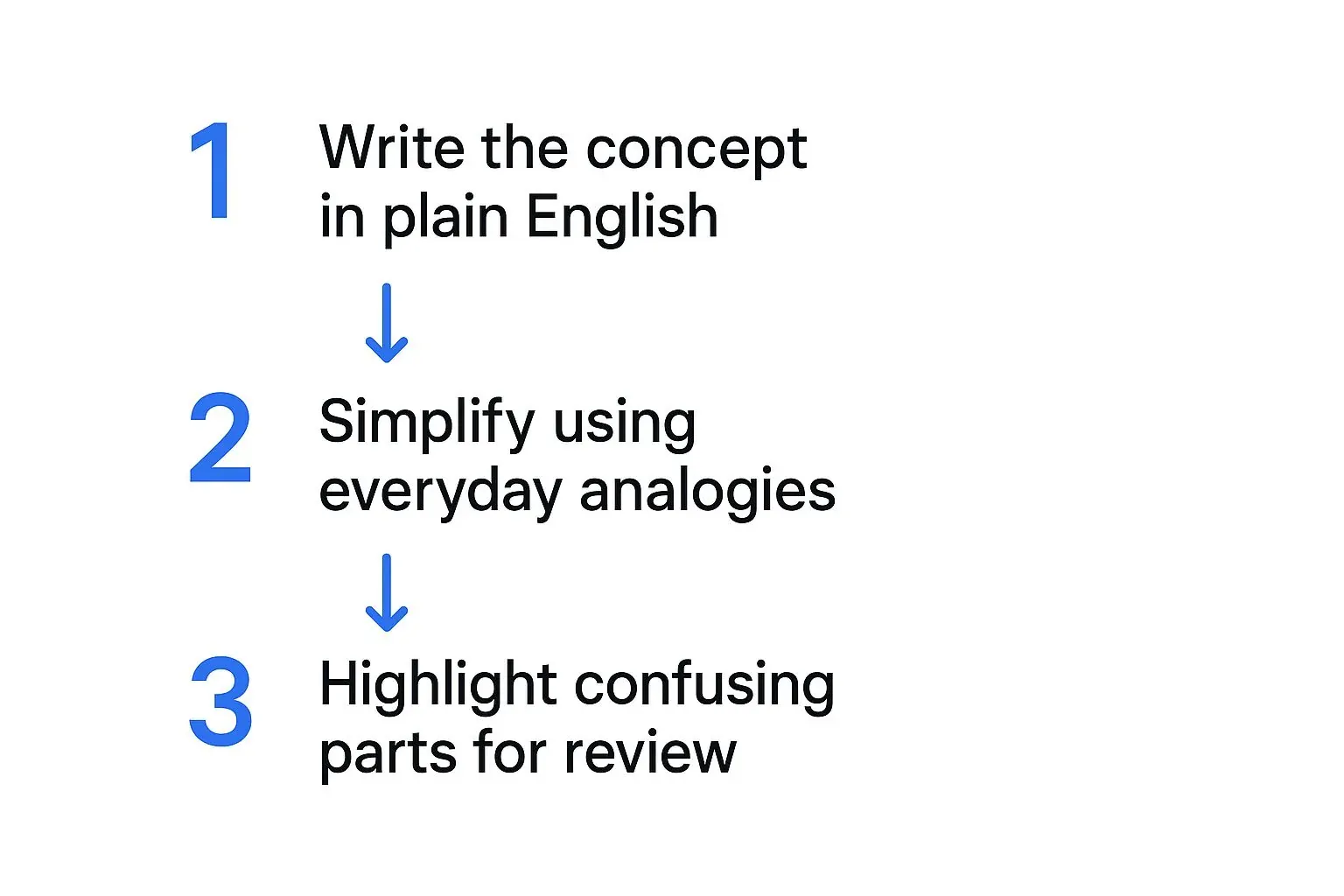
As the infographic shows, simplification isn't about dumbing things down. It's a diagnostic tool that precisely pinpoints where your own understanding is weak.
To give you a clearer picture of how this works across different fields, check out the table below. It shows how you can apply these steps to everything from science to the humanities.
| Subject Area | Step 1: Concept Selection | Step 2: Simple Explanation | Step 3: Gap Identification | Step 4: Refinement |
|---|---|---|---|---|
| Biology | Photosynthesis | "It's how plants use sunlight to make their own food, like a tiny solar-powered kitchen." | Stumbling on terms like "thylakoid membrane" or "Calvin Cycle." | Going back to the textbook to understand the specific roles of chloroplasts and light-dependent reactions. |
| History | The Cold War | "It was a big standoff between the USA and the Soviet Union. They never fought directly but competed everywhere." | Forgetting the specific triggers, like the Truman Doctrine or the Berlin Airlift. | Clarifying the timeline and connecting events to the broader ideological conflict. |
| Computer Science | Recursion | "It's like a set of Russian dolls. A function calls itself with a smaller version of the problem until it gets to the smallest doll." | Getting confused about the "base case" and why it's needed to prevent an infinite loop. | Drawing out the call stack to visualize how the function unwinds and returns a final value. |
| Economics | Supply and Demand | "If a lot of people want something but there isn't much of it, the price goes up. If there's a ton of it and no one wants it, the price drops." | Struggling to explain "elasticity" or how external factors (like a new tax) shift the curves. | Reworking the explanation to include how price sensitivity affects the supply and demand relationship. |
This table illustrates that no matter the subject, the core process remains the same: teach, simplify, identify weak points, and strengthen them. The result is a much more robust and flexible understanding.
#Identify the Gaps and Return to the Source
The moments you get stuck are the most important. When you find yourself forced to use a technical term like "heterolytic bond cleavage" because you can’t explain it simply, circle it. When your analogy doesn't quite work, make a note. These are your knowledge gaps.
This process is far more effective than passively rereading, which often gives you a false sense of mastery. Your list of identified gaps is now your highly-targeted study guide. Head back to your source material—lecture notes, textbooks, or saved articles—and concentrate only on those specific points until you can explain them with ease.
#Refine and Organize Your Knowledge
Now, take what you've learned and polish your original explanation. Rewrite the sections you struggled with until the language is smooth, clear, and simple. Once your explanation is solid, it's time to organize it. This is where a personal knowledge management (PKM) tool like Reseek can be a game-changer.
You can save each of your refined explanations as an individual note. Over time, you’ll build a personal, searchable library of concepts you truly understand. When it's time for a big exam, you can use Reseek's AI-powered semantic search to discover connections between topics—like how feudalism's economic structure laid some of the groundwork for early market economies. This helps you create a richer, more interconnected web of knowledge.
#Building Your Personal Learning Laboratory
Trying a new study method shouldn't feel like you have to completely overhaul your academic life. The real breakthrough comes when you weave the Feynman Technique for studying into the schedule and tools you already use. It’s like building your own personal learning lab—a space to tinker with ideas, pressure-test your knowledge, and organize what you discover for the long haul. The goal is to make it a natural part of your process, not just another task on your to-do list.
This shift to learning by explaining has become incredibly popular. Global interest in the Feynman Technique has exploded, with search queries jumping by roughly 300% between 2019 and 2024. A follow-up survey found that 65% of students who used it felt more confident explaining complex subjects, and 58% said they reduced their exam prep time by at least a quarter. You can dive deeper into these powerful learning trends and see how they’re helping students succeed.
#Creating a Digital Knowledge Base
While you can definitely start with just a notebook and a pen, using a digital tool can seriously level up your efforts. This is where a personal knowledge management (PKM) tool like Reseek can be a game-changer. Every time you work through the Feynman Technique and simplify an explanation, you're creating a solid, self-contained block of knowledge. Instead of letting that gem get lost in a cluttered folder, you can capture it in Reseek.
Here’s how that changes your workflow:
- Build a Searchable Library: Each of your simplified explanations becomes a note you can easily pull up later. When finals week rolls around, you’ll have your own curated library of concepts that you genuinely understand, not just memorized.
- Discover Hidden Connections: Reseek's AI-powered semantic search goes beyond simple keywords; it understands the context. You can search a broad topic, and it will surface related explanations you’ve written, helping you spot connections between different subjects you might have missed.
- Organize with Smart Tools: Tag your notes by course code (like "BIOL-101" or "HIST-250") or by broader themes ("cellular processes," "economic theories"). This keeps your learning lab organized and makes it easy to do targeted review sessions.
#Adapting the Technique for Your Schedule
Let's be real—your schedule is probably packed. You don't always have a full hour to wrestle with a single concept. The trick is to make the technique flexible enough to fit into your life, whether you’re studying alone or with a group.
For solo study, try the "five-minute Feynman." Just pick one small piece of a topic that confused you in a lecture. Spend five minutes—that's it—and try to write out a simple explanation. If you’re in a study group, you can assign one concept to each person. Everyone uses the technique to master their topic and then teaches it to the rest of the group. This not only reinforces everyone's understanding but also shows you different ways to explain the same idea.
#Overcoming the Learning Obstacles That Stop Most Students
Even a powerhouse strategy like the Feynman Technique has its sticking points. It's incredibly effective, but it’s not always a walk in the park. Many students get discouraged and quit when they hit their first serious roadblock. The most common one? Feeling completely swamped when a topic seems too dense to simplify. You stare at a complex concept and think, "There is no simple way to explain this."
This feeling usually points to a gap in your foundational knowledge, not a weakness in the technique itself. When you can't simplify something, it's often because you're missing a critical piece of the puzzle. Instead of throwing in the towel, this is your signal to dig deeper. Break the intimidating topic into its smallest parts and apply the technique to just one tiny piece. For example, rather than trying to explain all of "cellular respiration" at once, start by explaining only "glycolysis." Once you've got that down, you can move on to the next small component. This granular approach makes even the most daunting subjects manageable.
#Navigating Common Roadblocks
Another hurdle that frequently pops up is trying to explain abstract subjects. How do you explain a philosophical theory or a complex mathematical proof to a 12-year-old? The secret is to lean heavily on analogies and real-world scenarios. Think of it as translating an abstract idea into a concrete story. If you're stuck, it just means your analogy isn't quite right yet. Keep brainstorming until one clicks. This very process of hunting for the perfect metaphor is a powerful learning exercise in itself.
Getting stuck is an inevitable part of the process, but it doesn't have to stop you. To help you push through, here's a practical guide for troubleshooting the most common challenges people face with the Feynman Technique.
Common Feynman Technique Challenges and Solutions
A practical guide to overcoming the most frequent obstacles students encounter when implementing this method
| Challenge | Why It Happens | Immediate Solution | Long-term Strategy |
|---|---|---|---|
| "I can't simplify it!" | The topic is too broad, or there's a fundamental gap in your knowledge. | Break the concept into its smallest sub-topics. Focus on explaining just one piece. | Build your understanding from the ground up, ensuring you master foundational concepts before moving on. |
| Topic is too abstract | Abstract concepts lack tangible examples, making them hard to explain simply. | Brainstorm multiple analogies or real-world stories until one effectively captures the idea. | Create a personal library of analogies. For more ideas, check out these knowledge management best practices to organize your insights. |
| Losing momentum | Progress feels slow, and the constant review process becomes tedious. | Set a timer for a short "Feynman session" (15-20 minutes) to create a sense of urgency and focus. | Track your simplified explanations in a digital tool like Reseek. Seeing your library of knowledge grow provides a visual measure of progress and motivation. |
| Time management issues | The process seems too time-consuming for a packed study schedule. | Don't try to "Feynman" everything. Prioritize only the most complex or critical topics for your course. | Integrate the technique into your existing notes by adding a "Simple Explanation" summary to each section as you study it. |
In the end, the obstacles you run into are not failures; they are data points. Every time you get stuck, the technique is doing exactly what it’s supposed to do—it's shining a spotlight on precisely where you need to concentrate your effort. Pushing through these tough spots is where genuine, lasting comprehension is forged.
#Supercharging Your Results With Smart Digital Tools
While the Feynman technique is brilliant on its own with just a pen and paper, mixing it with the right digital tools can seriously boost your results. Smart platforms can take your simplified explanations from static notes and turn them into a dynamic, searchable knowledge ecosystem. This is how you go from just learning a topic to building a personal library of genuine understanding that grows and connects over time.
#Build a Smarter Knowledge Ecosystem
A big part of the Feynman technique for studying is organizing your refined explanations. This is where personal knowledge management (PKM) tools, especially those with AI features, become really helpful. For example, a platform like Reseek lets you save each of your simplified explanations, creating a solid, personal knowledge base.
Here’s how this approach makes your study sessions much more effective:
- Capture Everything: You can save your simplified text notes, links to source materials, and even photos of handwritten diagrams all in one spot. With a feature like AI-Powered OCR, you can snap a picture of your handwritten explanation, and the text instantly becomes fully searchable.
- Find Connections: As your knowledge base gets bigger, Reseek’s semantic search helps you notice connections you might have missed. A search for "cellular energy" could bring up your notes on both photosynthesis and cellular respiration, helping you see the bigger picture.
- Stay Organized: By tagging your notes by course or concept, you can immediately pull up all related materials for a focused review session. This turns scattered notes into an orderly and powerful study resource. To make your digital toolkit even more effective, think about checking out some of the top productivity apps for students that can work alongside this process.
Below is an example of how you can organize your digital content library within a platform like Reseek.
This image shows how you can transform digital clutter into an intelligently structured resource, making every piece of information you’ve learned easy to find. By centralizing your simplified explanations, you’re not just studying; you’re building a lasting and interconnected web of knowledge you can come back to and expand on for years.
#Your Roadmap to Learning Mastery
Mastering the Feynman technique isn't a race to the finish line. It's about building smart, sustainable habits that create real momentum. The trick is to start small and weave it into your current routine, rather than attempting a massive overhaul overnight. Small, consistent wins are what build confidence. For instance, try applying the technique to just one tricky concept from a single class this week.
#Tracking Progress Beyond Grades
Instead of obsessing over exam scores, pay attention to how your understanding deepens. Can you explain concepts more clearly than you could last week? Are your analogies becoming more intuitive and less forced? These are the true signs of mastery. Celebrating these small victories is what keeps you going, especially when midterms or finals week hits.
Once you get the hang of it, you can start using the technique for other topics and eventually, other subjects. This gradual approach keeps you from feeling overwhelmed and helps the habit stick for the long run. You'll find that your process naturally gets better over time. You'll spot your own knowledge gaps quicker and get much faster at refining your explanations.
This is where smart review strategies become your best friend. Don't just let those perfectly simplified notes gather digital dust in a folder. Reviewing them from time to time is crucial for locking that knowledge in for the long haul. A structured system makes all the difference here.
By building a personal library of your simplified explanations in a tool like Reseek, you create an powerful, interconnected web of knowledge. When it's time to prep for a big exam, you're not starting from zero. You'll have a searchable, organized collection of concepts you genuinely understand, all set for a quick and effective review. This shifts studying from a frantic cram session into a confident process of revisiting what you already know.
Ready to build your own personal learning laboratory and master complex subjects for good? Try Reseek today and start transforming your study notes into a powerful knowledge base.