Master Feynman Study Techniques to Learn Any Subject
Let's be honest, most of us were taught to study the same way: grab a highlighter, re-read our notes until our eyes glazed over, and pull a few late-night cram sessions.
#Why Most Students Never Learn How to Actually Learn
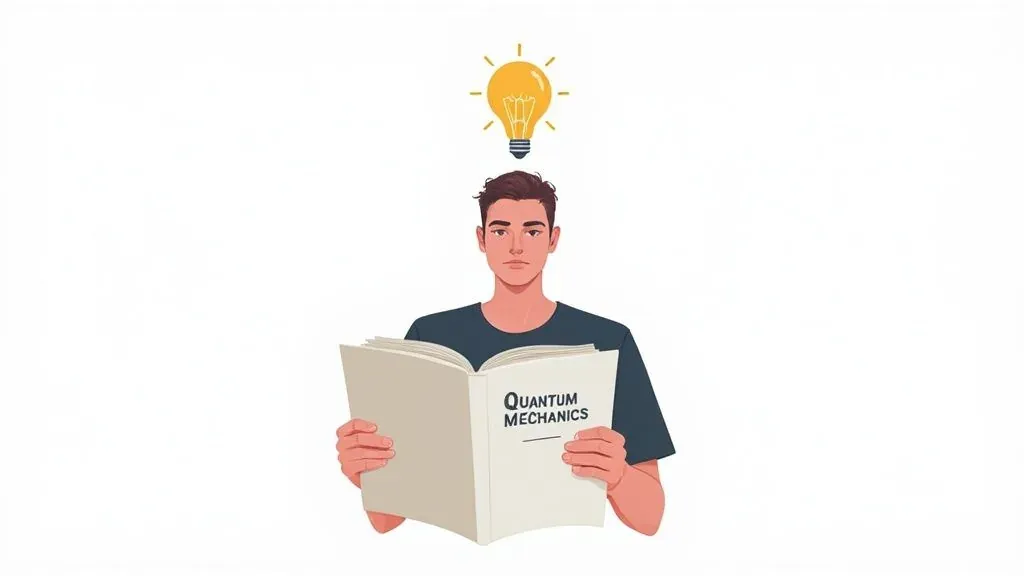
Let's be honest, most of us were taught to study the same way: grab a highlighter, re-read our notes until our eyes glazed over, and pull a few late-night cram sessions. These methods feel like real work, but they often create a dangerous illusion of knowledge. It's that feeling of familiarity you get from staring at a page for the fifth time, which your brain easily mistakes for actual understanding. Then, when the test comes, you draw a complete blank.
This gap between recognizing something and truly getting it is where learning usually falls apart. Passive habits like highlighting and re-reading don’t challenge your brain to connect the dots. You aren't questioning the ideas or trying to see how they fit together. You're just skimming the surface, which is exactly why someone can study for hours and still not be able to explain a core concept.
#The Myth of Effortless Learning
Here’s the hard truth: real learning is an active, and often messy, process. It's not about the number of hours you clock in but what you do with that time. The students who truly succeed approach learning as a two-way street. They are constantly testing themselves, questioning what they think they know, simplifying complex ideas, and even trying to teach the concepts to others.
To make the Feynman study techniques stick, you need a way to organize this active process. Imagine collecting all your scattered notes, confusing textbook chapters, and saved articles into one central place. A tool like Reseek can serve as your personal learning library, letting you gather all your resources. From there, you can search across everything you've saved, find hidden connections, and pinpoint exactly where your understanding is weak. This shifts studying from a passive chore into an active investigation.
#The Psychology Behind Feynman's Learning Revolution
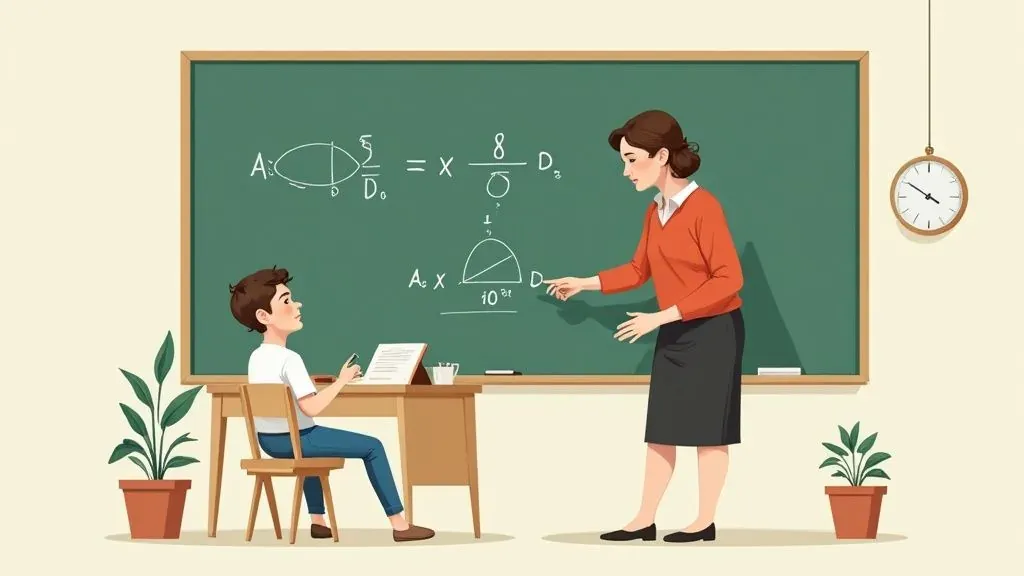
Richard Feynman didn't just invent a clever study trick; he tapped into the deep-seated principles of how our brains actually learn. The power of the Feynman study techniques feels like magic, but it’s really just cognitive science in action. At its heart, the method yanks you out of passive learning and throws you into active recall—the mental workout of pulling information out of your brain from scratch.
Think about it: just recognizing a term on a page is easy. But actually having to retrieve it and explain it? That’s where the real learning happens. This productive struggle strengthens the neural connections in your brain, cementing memories so they stick around for the long haul. When you try to simplify a complex idea, you're doing more than just repeating facts. You're forcing your brain to connect the dots, build a mental framework, and instantly see where your understanding is weak. It’s the difference between knowing a topic’s name and truly knowing the topic.
#From Theory to Practice
This isn't some new-age productivity fad. The technique's origins go back to Feynman's own relentless quest for genuine understanding in the mid-20th century. Throughout the 1960s and 1970s, he used this exact method not just for his famous lectures but also for his own pioneering research, including his work on the parton model in particle physics. While he developed it for himself rather than as a formal academic method, its cognitive benefits are clear. You can explore the history of his groundbreaking ideas to see how this approach directly shaped his discoveries.
#Organizing Your Learning Journey
Putting this mental powerhouse into practice requires a bit of organization. As you identify what you don't know, you’ll start collecting notes, articles, and better explanations. This is where a personal knowledge management tool like Reseek can be a game-changer. Instead of having notes scattered everywhere, you can save everything about a single concept—your first clumsy explanation, the source materials you found, and your final, polished analogies—all in one place.
With its AI-powered search, you can instantly see how different topics you've studied are connected. This makes the "review and refine" part of the Feynman method incredibly efficient. It helps you turn a chaotic pile of notes into an intelligent, interconnected map of your own knowledge.
#The Four Core Elements That Make Feynman Learning Work
The real magic of the Feynman technique isn't just one action, but how its different parts weave together to create a solid understanding. It's a complete cycle that pushes you to face what you don’t know, organize your thoughts, and build strong connections. Let’s move past a simple step-by-step list and look at the practical workflow that makes this study method so effective.
#Pick a Concept and Teach It Like a Pro
Start by choosing one manageable topic. Don't try to swallow "photosynthesis" whole; narrow it down to something specific, like "the Calvin cycle." Once you have your topic, grab a blank sheet of paper and pretend you're explaining it to an interested middle schooler. The goal here is to use your own simple words—no jargon or technical shortcuts. This first draft isn't about perfection; it's a diagnostic to see where your understanding really is.
This visual illustrates how the Feynman method acts like a magnifying glass, revealing the hidden holes in your knowledge.
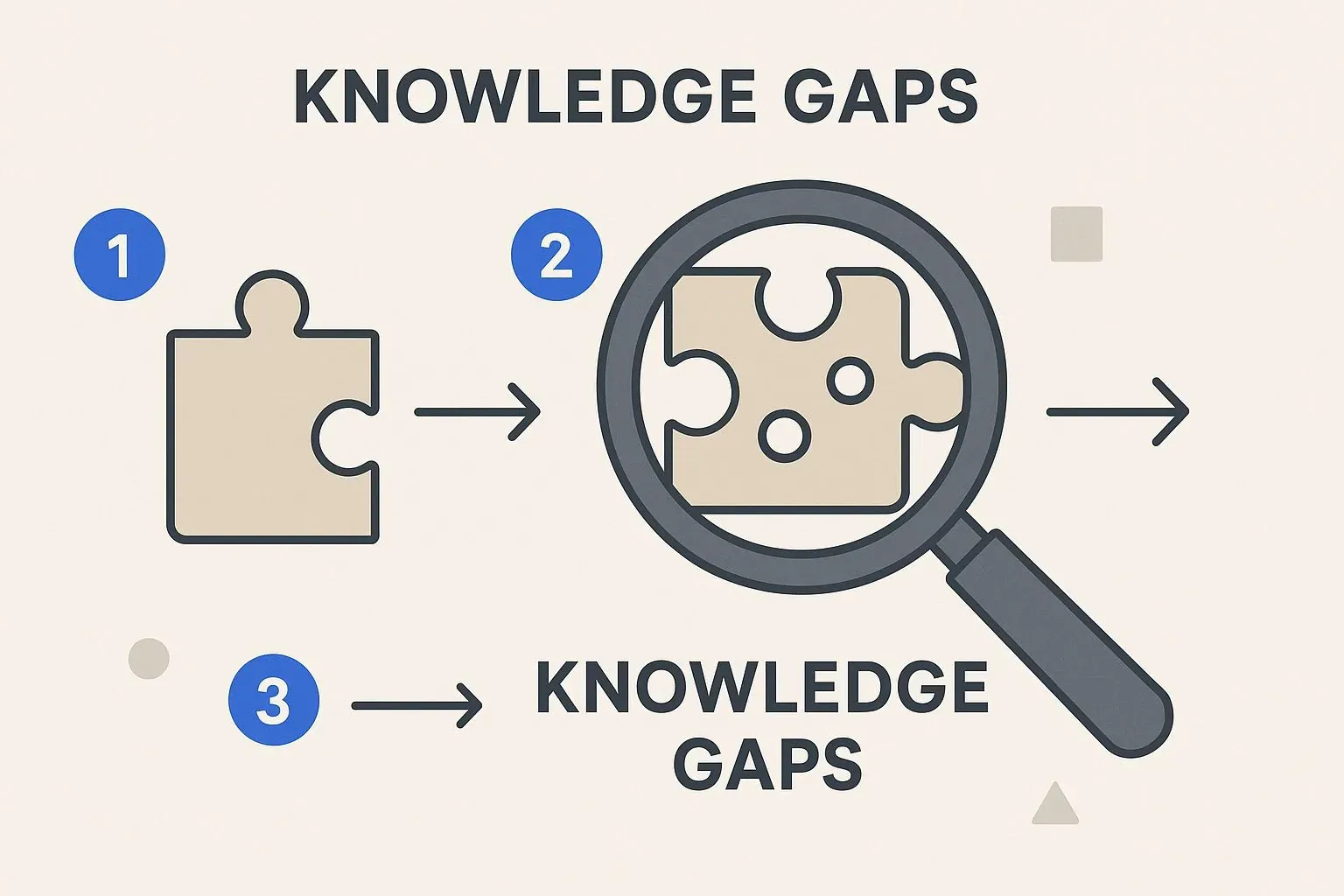
As the image shows, true learning isn't just collecting facts; it's about making sure those facts connect seamlessly without any missing pieces.
#Hunt Down Your Knowledge Gaps
As you write out your explanation, you’ll inevitably hit a snag. Maybe you’ll forget a key part of a sequence, struggle to explain why something happens, or fall back on a complex term because you can’t simplify it. These stumbling blocks are exactly what you're looking for. They are the knowledge gaps you need to address. Now, go back to your source material—textbooks, lecture notes, or articles—with a clear mission: find the specific answers to fill in only what you couldn't explain.
#Polish, Organize, and Simplify
Once your gaps are filled, it's time to rewrite your explanation from scratch. This time, your focus should be on crafting a smooth, logical story. This is where you really start to master the Feynman study techniques. To give you a clearer picture of this workflow, here’s a breakdown of the entire process.
The Four Stages of Feynman Learning
A detailed breakdown of each stage with specific actions and expected outcomes
| Stage | Core Action | Key Questions | Success Indicators |
|---|---|---|---|
| 1. Teach | Explain the concept in simple terms on a blank page. | Can I explain this so a 12-year-old would get it? Am I using my own words? | You have a written explanation, even if it's rough and has noticeable holes. |
| 2. Review | Identify the specific points where you struggled or used jargon. | Where did I get stuck? What terms couldn't I simplify? Why does this part work the way it does? | You have a clear list of specific questions and concepts you need to research further. |
| 3. Research | Return to your source materials to fill only your identified gaps. | What is the specific answer to my question? How does this piece connect to what I already know? | You've found targeted answers and can now explain the previously confusing parts. |
| 4. Refine | Rewrite the entire explanation, integrating your new knowledge into a simple, cohesive narrative. | Is my new explanation clear and logical? Can I read it aloud without stumbling? | You have a polished, easy-to-understand explanation that you truly comprehend. |
This table shows that the technique, originally developed by Nobel laureate Richard Feynman, is more than just simplifying; it’s a structured, four-part process for achieving deep comprehension. You can find more insights on this powerful process on fs.blog.
This cycle of teaching, reviewing, and refining is the key to building knowledge that sticks. If you're looking for a structured way to apply this, check out our guide on what is the Feynman technique, which offers a deeper look into mastering complex subjects fast. This method helps turn jumbled, half-understood ideas into clear, simple knowledge.
#Real Students, Real Subjects: Feynman In Action
The theory behind the Feynman technique sounds great, but seeing it work with real subjects is where its true power becomes clear. Let's move beyond the abstract and look at how this method plays out for students tackling some notoriously difficult topics.
#From Calculus to Code
Imagine a computer science student getting tangled up in the concept of recursion. They might start by trying to explain it simply: "It's when a function calls itself." While true, that’s just a definition, not an explanation that builds real understanding. Hitting that wall is a sign to go back to the books.
This time, they come up with a story: recursion is like a set of Russian nesting dolls. You open one to find a slightly smaller one inside, and you keep going until you reach the smallest doll that can't be opened. That final doll is the base case in programming. Suddenly, this simple analogy makes the abstract concept click.
A pre-med student could use the same approach for organic chemistry, a subject famous for its complexity. Instead of just memorizing reaction diagrams, they would explain the flow of electrons as a story. It could be about "electron-rich" areas wanting to connect with "electron-poor" areas. This process quickly highlights any gaps where they don't truly grasp why a certain bond breaks or forms.
#Making It Stick with Digital Tools
Going through these cycles of drafting, spotting gaps, and refining your explanation can create a lot of notes. Instead of ending up with a messy pile of papers, you can use modern tools to keep everything organized. A personal knowledge management platform like Reseek is perfect for this. It lets you save your first drafts, the resources you used to fill in the blanks, and your final, polished explanations all in one searchable spot. Its AI features can even help you spot connections between a new programming concept and a math topic you studied last month.
The results speak for themselves. One student who was wrestling with statistical concepts like population parameters found that trying to explain them to a hypothetical middle schooler made a huge difference. By ditching the textbook jargon and simplifying everything, they reached a level of clarity that just reading could never provide. You can see how they got better grades and learn more about their experience with this method.
For a complete guide on how to apply this method from start to finish, you might want to read our deep dive into the Feynman technique for studying.
#Building Your Digital Learning Laboratory
While Richard Feynman famously got by with just notebooks and blackboards, we can build a much more powerful digital learning space today. This is where modern Feynman study techniques really come alive, helping you move from scattered notes to a smart, connected system. Instead of losing valuable insights in forgotten bookmarks or messy documents, you can create an intelligent library for everything you learn.
#Modern Tools for Deep Understanding
Think of a platform like Reseek as your personal lab for knowledge. It’s designed to support this exact cycle of learning and understanding. You can save everything related to a concept in one spot: the initial article you read, that YouTube video with a perfect analogy, and even your own clumsy first attempts at an explanation. This creates a rich, interconnected web of information that only grows more valuable over time.
This approach is far more dynamic than a physical notebook. Here’s how you can create a practical workflow with it:
- Capture Everything: Save articles, videos, and even social media posts about your topic. With features like AI-Powered OCR, Reseek can pull text from images, making sure no piece of information is left behind.
- Connect Your Ideas: Use smart tagging to link concepts across different subjects. For example, you might connect a principle from economics with a similar pattern you noticed in psychology.
- Find Your Gaps: When you hit a wall in your explanation, the semantic search feature is a game-changer. You can search for a confusing term and instantly pull up every related resource you’ve ever saved, quickly showing you where your understanding breaks down.
To give you a clearer picture, here's a look at how traditional study tools stack up against modern digital alternatives for applying the Feynman technique.
| Traditional Method | Digital Alternative | Key Benefits | Best Use Cases |
|---|---|---|---|
| Pen and Notebook | Digital Note-taking Apps (e.g., Notion, Evernote) | Searchable, easily reorganized, can include multimedia. | Organizing thoughts, drafting explanations, quick notes. |
| Physical Whiteboard | Digital Whiteboard Tools (e.g., Miro, Mural) | Infinite canvas, collaborative features, easy to save/share. | Mind-mapping complex topics, brainstorming connections. |
| Library/Textbooks | Knowledge Management Platforms (e.g., Reseek) | Centralized repository, semantic search, AI-powered OCR. | Building a long-term, interconnected knowledge base. |
| Sticky Notes | Digital Sticky Notes/Tagging | Non-destructive, easy to group and filter, can link to sources. | Highlighting gaps, tagging key concepts for review. |
As you can see, digital tools offer a significant upgrade in flexibility and power, turning a simple study method into a robust knowledge-building system.
This organized method turns studying into a sustainable practice. Instead of starting from scratch each time, you build upon a solid foundation you've already created. If you’re interested in building a robust system for your knowledge, you can explore more knowledge management strategies to implement now that pair perfectly with this technique.
#Overcoming The Obstacles Every Learner Faces
Even the best learning methods can present challenges, and the Feynman technique is no different. It's perfectly normal to feel overwhelmed when tackling a massive topic or to hit a wall when you just can't seem to simplify a concept. This is the point where many people get frustrated and think about quitting. But the solution isn't to give up; it's to tweak your strategy.
#When Concepts Seem Unbreakable
If a topic feels too big to grasp, you might be trying to swallow it whole. The trick is to break it down into smaller, more digestible pieces. Instead of trying to explain "macroeconomics" all at once, zoom in on a single component like "supply and demand." Once you master that small piece, you'll have the confidence and foundation to connect it to the next one. It's worth remembering that Feynman himself kept a "Notebook Of Things I Don’t Know About" to isolate and focus on specific points of confusion.
Another common point of friction is the simplification step. What do you do if you can't make it simple? This is actually a great sign—it shows you exactly where your own understanding is still fuzzy. When this happens, try a couple of things:
- Create an Analogy: Link the new concept to something you already understand deeply. Explaining electrical resistance by comparing it to water flowing through pipes of different sizes can make an abstract idea concrete.
- Draw It Out: Sometimes, words just get in the way. A quick diagram, flowchart, or mind map can often clarify a process that feels tangled when you try to explain it verbally.
These hurdles are a sign that you're engaging in deep learning. As you collect different explanations, videos, and your own notes, keeping everything organized becomes critical. A platform like Reseek can help you build a dedicated library for each subject, making it easy to see all your materials in one place. When you feel stuck, you can quickly scan your resources and find that one article or video that finally makes things click.
Ready to build your own intelligent learning library and master any subject? Get started with Reseek for free and transform how you learn.