
8 Knowledge Management Strategies to Implement Now
Knowledge is power. But only when it's effectively managed. This article reveals eight key knowledge management strategies to transform how your team captures, shares, and uses its collective…
#Unlocking Team Potential: A Deep Dive into Knowledge Management Strategies
Knowledge is power. But only when it's effectively managed. This article reveals eight key knowledge management strategies to transform how your team captures, shares, and uses its collective expertise. We'll explore practical steps for each strategy, demonstrating how they fuel productivity, innovation, and success. Critically, we’ll also highlight how Reseek, a powerful AI-powered knowledge management platform, supercharges these strategies. Ready to unlock your team’s full potential? Let's dive in.
This listicle provides actionable insights to implement these essential knowledge management strategies:
- Codification Strategy
- Personalization Strategy
- Communities of Practice
- Knowledge Mapping
- After-Action Reviews & Lessons Learned
- Storytelling
- Social Collaboration Platforms
- Gamification
Each strategy offers a unique approach to optimizing knowledge flow within your team. We’ll move beyond generic advice, offering fresh perspectives and practical examples. You’ll learn how to implement these strategies immediately, generating tangible results.
Reseek amplifies the effectiveness of these knowledge management strategies. Not just a link saver, Reseek scrapes titles, descriptions, and images, enabling powerful AI-driven semantic search. Forget keyword limitations; search using context. Reseek's OCR capabilities extract text from images and receipts, storing it in a vector database for seamless retrieval. Archive social media posts (currently Twitter/X) regardless of content type (text, image, or video). Future updates include PDF and video archiving with AI-powered content extraction. Reseek transforms how you manage and leverage information, making these eight knowledge management strategies even more impactful.
#1. Codification Strategy
A Codification Strategy is a systematic approach to knowledge management. It focuses on capturing, storing, and retrieving explicit knowledge. Think of it as building a meticulously organized library of your organization's collective intelligence. This centralized repository houses crucial information like documents, databases, best-practice guides, and FAQs, making it easily accessible and reusable. This approach transforms scattered information into a powerful asset, fueling innovation and informed decision-making across the organization.

#Examples of Codification in Action
Real-world examples demonstrate the power of codification. McKinsey’s internal knowledge center, with its practice-area libraries, provides consultants with rapid access to best practices and research. NASA’s Lessons Learned Information System captures critical insights from past missions, preventing costly mistakes and accelerating future explorations. These examples highlight how codified knowledge translates to tangible benefits.
#Actionable Tips for Implementing a Codification Strategy
- Define clear taxonomy and metadata standards upfront: A well-defined structure is the backbone of a successful codification strategy. It ensures consistent organization, making information retrieval quick and intuitive.
- Assign content stewards: Dedicated stewards ensure the repository remains up-to-date and accurate. They review and update entries regularly, maintaining the integrity of the knowledge base.
- Use templates for consistency: Templates streamline the process of adding new information. They ensure uniformity and make it easier for users to contribute and consume content.
#When and Why to Use a Codification Strategy
Codification is particularly effective when dealing with explicit knowledge – information that can be easily documented and shared. It's ideal for organizations that rely heavily on standardized processes, best practices, and readily available information. This strategy thrives in environments where efficient knowledge sharing is critical for success.
#Benefits of Codification
Codification significantly improves knowledge accessibility, reduces redundancy, and promotes consistency in decision-making. It fosters a culture of knowledge sharing, empowering employees to learn from each other and build upon existing expertise. This results in improved efficiency, reduced training costs, and faster problem-solving.
#Reseek: Supercharging Your Codification Strategy
Reseek significantly enhances codification efforts. It allows you to save more than just links. It also scrapes titles, descriptions, and images, creating a rich and easily searchable knowledge base. Forget remembering exact keywords; Reseek's AI-powered search lets you find information based on context.
#Reseek's Unique Advantages
- Image Search: Reseek extracts OCR data from images, receipts, and more, saving it in a vector database for semantic search. This allows for powerful image-based knowledge retrieval.
- Social Media Archiving: Archive Twitter/X posts, including text, images, and videos, by simply saving the link. Reseek scrapes the content for easy access and analysis.
- Future Capabilities: Reseek is constantly evolving, with upcoming features for PDF and video archiving, leveraging context extraction for even richer search capabilities.
This powerful combination of codification and Reseek's advanced features transforms how you manage and leverage your organization's knowledge, leading to a more informed, innovative, and efficient future. This approach caters to diverse users, from knowledge workers and researchers to students and content creators, providing a powerful solution for centralized information management. It also benefits those interested in personal knowledge management (PKM) and AI-powered bookmark management.
#2. Personalization Strategy
A Personalization Strategy in knowledge management shifts the focus from document-centric approaches to "person-to-person" connections. It leverages the power of direct interaction to share tacit knowledge – the kind of expertise that's often difficult to capture in written form. This strategy fosters a dynamic learning environment through mentoring programs, communities of interest, expert directories, and peer coaching, empowering individuals to tap into a wealth of experience within the organization.

#Examples of Personalization in Action
Leading organizations recognize the value of personalized knowledge sharing. Microsoft's internal Expert Finder connects employees with subject-matter experts, facilitating rapid problem-solving and skill development. Similarly, Deloitte's guidance circles match junior and senior consultants, fostering mentorship and accelerating professional growth. These initiatives demonstrate the tangible benefits of connecting people with expertise directly.
#Actionable Tips for Implementing a Personalization Strategy
- Maintain up-to-date expert profiles: Accurate profiles are essential for effective matching and knowledge sharing. Regularly updated profiles ensure individuals can quickly find the right expertise when needed.
- Provide incentives and recognition for mentors: Recognizing and rewarding mentors encourages active participation and reinforces the value of knowledge sharing.
- Blend with codification: Capture key insights from personalized interactions. Documenting lessons learned and best practices from mentoring sessions and communities of practice amplifies the impact of the personalization strategy. Learn more about Personalization Strategy can provide further insights into effective implementation.
#When and Why to Use a Personalization Strategy
Personalization is most effective when dealing with tacit knowledge, complex problem-solving, or situations requiring nuanced understanding. It excels in environments where innovation, collaboration, and rapid learning are critical for success. This strategy fosters a culture of continuous learning and development.
#Benefits of Personalization
A Personalization Strategy fosters stronger relationships, accelerates knowledge transfer, and promotes a more collaborative work environment. It empowers individuals to learn from each other's experiences, leading to faster problem-solving and improved decision-making. This translates to increased innovation and improved organizational performance.
#Reseek: Amplifying Your Personalization Strategy
Reseek significantly enhances personalization efforts by providing a powerful platform to capture and share knowledge gleaned from these interactions. It allows you to save more than just links, scraping titles, descriptions, and images to create a rich, searchable knowledge base. This aids in documenting insights from mentoring sessions or community discussions, making them easily accessible for future reference.
#Reseek's Unique Advantages
- AI-Powered Search: Forget remembering exact keywords. Reseek’s AI search lets you find information based on context, making it easy to retrieve the knowledge you need.
- Image Search: Reseek extracts OCR data from images and receipts, saving it for semantic search. This facilitates capturing visual knowledge shared during personalized interactions.
- Social Media Archiving: Archive Twitter/X posts (text, images, and videos) by saving the link. Reseek scrapes the content for easy access and analysis, allowing you to capture knowledge shared on social platforms. Future capabilities include PDF and video archiving, leveraging context extraction for even richer search.
This powerful combination of personalization and Reseek's advanced features transforms how you manage and leverage your organization's knowledge, creating a more connected, informed, and innovative future. This benefits knowledge workers, researchers, students, content creators, social media managers, and anyone interested in personal knowledge management (PKM) and AI-powered bookmark management. It greatly aids "knowledge management strategies" by facilitating efficient and effective knowledge capture and retrieval.
#3. Communities of Practice
A Community of Practice (CoP) is a powerful, organic approach to knowledge management. It leverages the collective intelligence of individuals who share a common interest or domain expertise. These self-organizing groups meet regularly, fostering a dynamic environment for sharing challenges, best practices, and generating new knowledge through open dialogue. Think of it as a vibrant hub where expertise flourishes and innovation sparks. This collaborative approach transforms individual knowledge into a shared asset, driving continuous learning and improvement within the organization.

#Examples of Communities of Practice in Action
Real-world examples illustrate the impact of CoPs. IBM boasts over 500 Communities of Practice, spanning technical and business domains, fostering collaboration and innovation across the company. Caterpillar utilizes dealer CoPs focused on machinery maintenance best practices, resulting in improved service quality and customer satisfaction. These examples demonstrate how shared knowledge within CoPs translates to tangible business benefits.
#Actionable Tips for Implementing Communities of Practice
- Provide a dedicated facilitator or champion: A dedicated individual can help guide the CoP, ensuring its effectiveness and alignment with organizational goals.
- Align CoP objectives with business outcomes: Connecting CoP activities to strategic objectives ensures relevance and maximizes impact.
- Encourage cross-community exchanges: Facilitating communication between different CoPs promotes cross-pollination of ideas and broader knowledge sharing.
#When and Why to Use Communities of Practice
Communities of Practice are particularly effective when tackling complex challenges, fostering innovation, and promoting continuous learning. They thrive in environments where collaboration and knowledge sharing are valued. This strategy is ideal for organizations seeking to tap into the collective intelligence of their workforce and drive organic knowledge growth.
#Benefits of Communities of Practice
CoPs foster a culture of shared learning, accelerate problem-solving, and drive innovation. They enhance employee engagement and create valuable networks of expertise. This leads to improved organizational performance, increased agility, and a more knowledgeable workforce.
#Reseek: Supercharging Your Communities of Practice
Reseek can significantly enhance the effectiveness of your Communities of Practice. It allows members to not only save relevant links, but also captures titles, descriptions, and images, creating a rich and easily searchable knowledge repository for the CoP. Forget remembering exact keywords; Reseek's AI-powered search enables members to find information based on context.
#Reseek's Unique Advantages
- Image Search: Reseek extracts OCR data from images, receipts, and more, saving it in a vector database for semantic search. This allows for powerful image-based knowledge retrieval within the CoP.
- Social Media Archiving: Archive Twitter/X posts, including text, images, and videos, by simply saving the link. This feature enables CoP members to curate and share relevant social media content.
- Future Capabilities: Reseek is continuously evolving, with upcoming features for PDF and video archiving, leveraging context extraction for even richer search capabilities, further enhancing CoP knowledge sharing.
This potent combination of Communities of Practice and Reseek's advanced features revolutionizes knowledge management within your organization. It cultivates a more informed, innovative, and efficient workforce. This integrated approach caters to knowledge workers, researchers, and anyone seeking to leverage the power of collective intelligence. It also benefits those focused on personal knowledge management (PKM) and AI-powered information retrieval.
#4. Knowledge Mapping
Knowledge mapping is a powerful knowledge management strategy that creates visual representations of an organization's collective know-how. Think of it as a dynamic blueprint of your intellectual capital. These "maps" illuminate where expertise resides, how information flows, and where knowledge gaps or redundancies exist. This clear visualization guides knowledge sharing, resource allocation, and strategic decision-making.
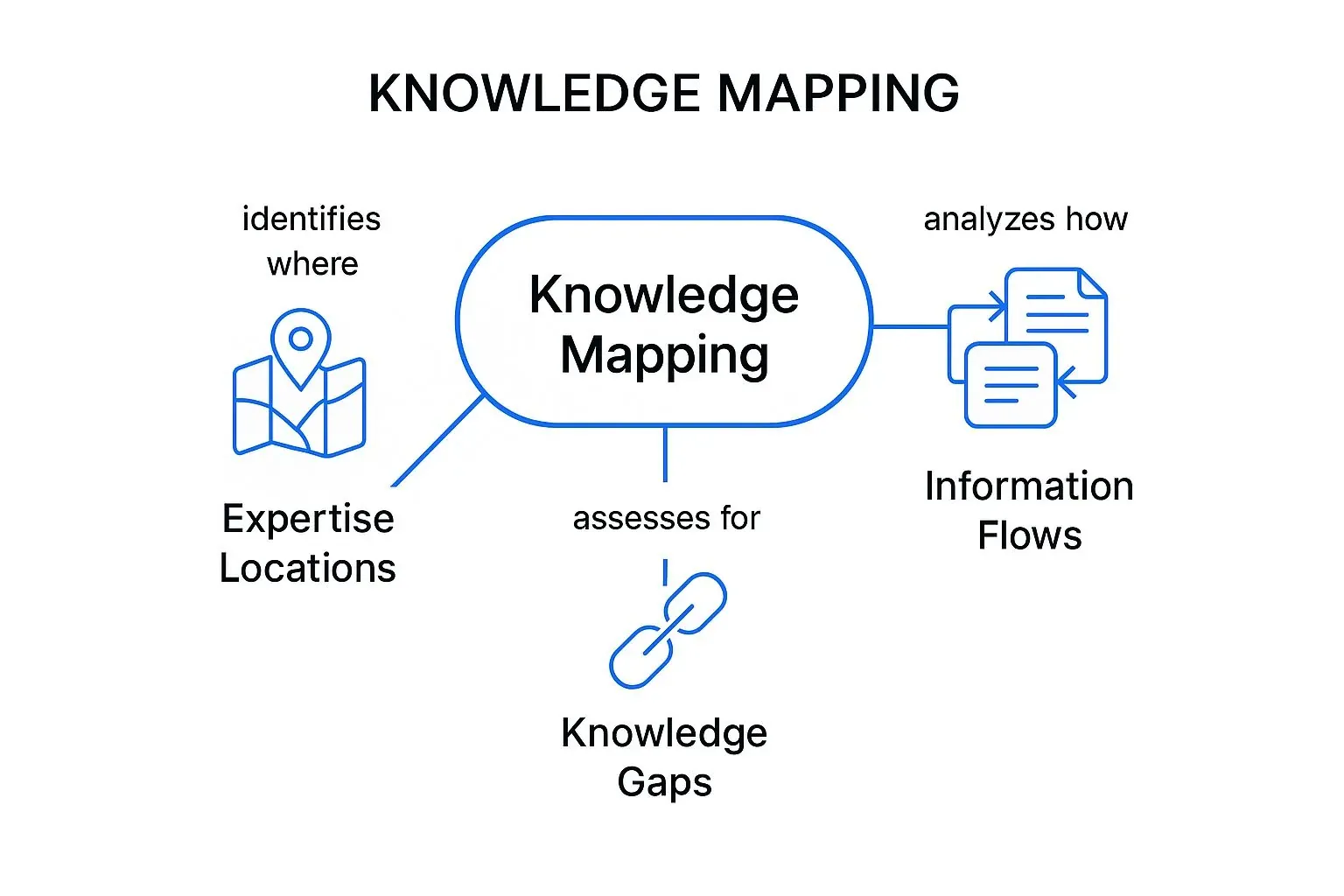
This infographic visualizes the core components of knowledge mapping: expertise locations, information flows, and knowledge gaps. The visualization highlights the interconnectedness of these elements, emphasizing the importance of understanding each aspect to effectively map an organization's knowledge landscape.
#Examples of Knowledge Mapping in Action
Real-world examples showcase the practical application of knowledge mapping. Shell, for instance, utilizes a global knowledge map to pinpoint experts in exploration and production by region. Siemens leverages competency maps to track engineering skills across different divisions. These maps enable these organizations to quickly identify and connect with the right people for specific projects and challenges.
#Actionable Tips for Implementing a Knowledge Mapping Strategy
- Use surveys and interviews to validate data: Gathering input directly from employees ensures the accuracy and relevance of your knowledge map.
- Automate updates where possible: Integrating with HR and project management systems keeps the map current and reduces manual effort.
- Display maps in an interactive, drill-down format: This enhances usability and allows users to explore specific areas of interest in greater detail.
#When and Why to Use a Knowledge Mapping Strategy
Knowledge mapping is particularly valuable when onboarding new employees, identifying skill gaps, facilitating collaboration, and making informed decisions about resource allocation. It's especially beneficial for organizations undergoing change or experiencing rapid growth, enabling them to effectively manage their evolving knowledge base. Learn more about knowledge mapping and other best practices in our article: Learn more about….
#Benefits of Knowledge Mapping
Knowledge mapping significantly improves knowledge discovery, facilitates expertise sharing, and identifies critical knowledge gaps. This leads to better decision-making, enhanced innovation, and increased organizational agility.
#Reseek: Enhancing Your Knowledge Mapping Strategy
Reseek greatly enhances knowledge mapping efforts by providing a powerful platform for capturing and organizing information. It goes beyond simply saving links, scraping titles, descriptions, and images to create a rich, searchable knowledge base. Reseek's AI-powered search allows you to find information based on context, not just keywords.
#Reseek's Unique Advantages
- Image Search: Extract OCR data from images and receipts, saving them in a vector database for semantic search.
- Social Media Archiving: Archive Twitter/X posts, including text, images, and videos, for easy access and analysis.
- Future Capabilities: Upcoming features include PDF and video archiving, leveraging context extraction for even richer search capabilities.
This combination of knowledge mapping and Reseek transforms how organizations manage and leverage their intellectual assets. It empowers knowledge workers, researchers, students, and content creators alike with a powerful solution for centralized information management and retrieval. It’s also a valuable tool for personal knowledge management and AI-powered bookmarking.
#5. After-Action Reviews & Lessons Learned
After-Action Reviews (AARs) and Lessons Learned sessions are structured debriefs conducted immediately following a project, event, or milestone. They systematically capture what worked well, what didn't, and actionable recommendations. This valuable information is then fed back into processes and databases, becoming a powerful resource for future projects. This proactive approach transforms experience into actionable insights, fostering continuous improvement and preventing recurring mistakes.
#Examples of AARs and Lessons Learned in Action
The U.S. Army's After-Action Review process is a prime example of this strategy's effectiveness. It has been instrumental in improving training and operational efficiency. Similarly, BP utilizes post-incident reviews in its safety-critical operations to identify vulnerabilities and prevent future accidents. These examples demonstrate how capturing and applying lessons learned can significantly enhance performance and safety.
#Actionable Tips for Implementing AARs and Lessons Learned
- Assign an impartial facilitator: An objective facilitator encourages open communication and ensures all perspectives are heard. This leads to a more comprehensive understanding of the event and its outcomes.
- Capture outcomes in a searchable repository: Storing AAR results in a central, accessible database allows for easy retrieval and analysis. This ensures valuable insights are readily available for future projects.
- Assign clear owners to follow up on action items: Accountability is crucial for translating insights into tangible improvements. Assigning owners ensures recommended actions are implemented and tracked effectively.
#When and Why to Use After-Action Reviews and Lessons Learned
This knowledge management strategy is highly effective in dynamic environments where learning from experience is crucial. It's particularly beneficial for project-based organizations, teams navigating complex challenges, and any group seeking to improve performance through continuous learning. This proactive approach fosters a culture of reflection and adaptation.
#Benefits of After-Action Reviews and Lessons Learned
AARs and Lessons Learned sessions significantly improve organizational learning, reduce errors, and enhance decision-making. They promote a culture of continuous improvement, empowering teams to learn from both successes and failures. This translates to increased efficiency, better risk management, and improved project outcomes.
#Reseek: Supercharging Your After-Action Reviews
Reseek greatly enhances the impact of After-Action Reviews and Lessons Learned. It allows you to save more than just links to meeting notes or reports. Reseek scrapes titles, descriptions, and even images, creating a rich and easily searchable knowledge base. Forget remembering exact keywords; Reseek's AI-powered search lets you find information based on context.
#Reseek's Unique Advantages
- Image Search: Reseek extracts OCR data from images, receipts, and whiteboard photos from your AARs, saving it in a vector database for semantic search. This allows for powerful image-based knowledge retrieval.
- Social Media Archiving: If your AARs involve social media feedback, archive relevant Twitter/X posts, including text, images, and videos, simply by saving the link. Reseek scrapes the content for easy access and analysis.
- Future Capabilities: Reseek is constantly evolving, with upcoming features for PDF and video archiving. These will leverage context extraction for even richer search capabilities within your AAR repository.
This powerful combination of AARs, Lessons Learned, and Reseek transforms how you manage and leverage organizational knowledge. It fosters a more informed, innovative, and efficient approach to project management and organizational learning, leading to better outcomes and continuous improvement.
#6. Storytelling
Storytelling is a powerful knowledge management strategy that leverages narratives to convey complex, often tacit, knowledge. It connects data and lessons to real experiences and characters, making insights more relatable, emotionally resonant, and memorable. Instead of dry reports or abstract concepts, storytelling brings knowledge to life, fostering deeper understanding and retention. This human-centric approach transforms information into compelling narratives that resonate with audiences and inspire action.
#Examples of Storytelling in Action
Several organizations effectively utilize storytelling for knowledge management. Shell, for example, maintains a "story bank" documenting engineering breakthroughs, capturing the challenges, solutions, and learnings in engaging narratives. GE's Edison Museum-style exhibits showcase internal innovation stories, inspiring employees and preserving valuable institutional knowledge. These examples demonstrate how narratives can effectively transmit complex information and inspire future innovation.
#Actionable Tips for Implementing a Storytelling Strategy
- Capture stories close to the source event: The closer you are to the source, the richer and more accurate the narrative. Interview key individuals involved and document their experiences while the details are fresh.
- Train employees in basic storytelling techniques: Equip your team with the skills to craft compelling narratives. This includes structuring stories, identifying key takeaways, and using evocative language.
- Archive stories with metadata for easy retrieval: Organize your stories with relevant tags and keywords to ensure easy access. This allows users to quickly find relevant narratives based on specific topics or themes.
#When and Why to Use a Storytelling Strategy
Storytelling excels when conveying tacit knowledge – the kind of understanding that’s difficult to document explicitly. It's especially effective for sharing lessons learned, best practices, and complex problem-solving approaches. This strategy thrives in environments where knowledge transfer depends on personal experiences and contextual understanding.
#Benefits of Storytelling
Storytelling significantly enhances knowledge retention and engagement. It fosters a deeper understanding of complex concepts by connecting them to relatable human experiences. It also strengthens organizational culture by sharing collective narratives and celebrating shared successes. This approach facilitates knowledge transfer and builds a stronger sense of community.
#Reseek: Amplifying Your Storytelling Strategy
Reseek can greatly enhance storytelling efforts. It allows you to save more than just links to articles or videos containing stories. It scrapes titles, descriptions, and images, creating a rich and searchable repository of narratives. Forget remembering exact keywords; Reseek's AI-powered search allows you to find information based on context, making it easy to access relevant stories.
#Reseek's Unique Advantages for Storytelling
- Image Search: Reseek extracts OCR data from images associated with stories, preserving valuable visual context. This data is saved in a vector database for semantic search, enabling powerful image-based retrieval of relevant narratives.
- Social Media Archiving: Archive social media posts containing stories, including text, images, and videos, by simply saving the link. Reseek scrapes the content for easy access and analysis, creating a centralized repository for social storytelling.
- Future Capabilities: Reseek is constantly evolving with upcoming features for PDF and video archiving. This will leverage context extraction for even richer search capabilities, making it even easier to find and share compelling narratives.
This powerful combination of storytelling and Reseek's advanced features transforms how you manage and leverage narrative knowledge. This leads to a more informed, innovative, and connected organization by capturing and sharing the human experiences behind the data. This approach is beneficial for anyone looking to harness the power of stories for knowledge sharing, including researchers, educators, and corporate trainers.
#7. Social Collaboration Platforms
Social Collaboration Platforms represent a dynamic approach to knowledge management. They leverage the power of enterprise social networks, chat tools, wikis, and collaborative workspaces. This creates a single digital ecosystem for real-time knowledge sharing, vibrant discussion threads, seamless file co-editing, and informal learning. Think of it as a virtual water cooler, where ideas flow freely and expertise is readily accessible.
#Examples of Social Collaboration in Action
Real-world examples highlight the effectiveness of social collaboration. Deloitte's adoption of Yammer connects over 50,000 professionals, fostering a culture of open communication and knowledge exchange. Similarly, SAP Jam facilitates cross-team innovation projects by providing a central hub for collaboration and idea generation. These examples demonstrate how social collaboration platforms can break down silos and unlock collective intelligence.
#Actionable Tips for Implementing Social Collaboration Platforms
- Establish clear usage guidelines and etiquette: This ensures respectful and productive interactions, maximizing the value of the platform.
- Promote power users and champions to seed discussions: These individuals can ignite engagement and encourage widespread participation.
- Use analytics to monitor engagement and content gaps: Data-driven insights help refine the platform's use and address unmet knowledge needs.
#When and Why to Use Social Collaboration Platforms
Social collaboration platforms are particularly effective when fostering a culture of open communication and collaborative learning. They are ideal for organizations seeking to break down silos, encourage knowledge sharing, and tap into the collective intelligence of their workforce. This approach is particularly valuable in fast-paced environments where real-time information access is crucial. Learn more about Social Collaboration Platforms.
#Benefits of Social Collaboration Platforms
Social collaboration platforms significantly enhance knowledge sharing, accelerate problem-solving, and foster a sense of community. They facilitate rapid dissemination of information, encourage peer-to-peer learning, and empower employees to contribute their expertise. This translates to increased innovation, improved decision-making, and a more agile organization.
#Reseek: Supercharging Your Social Collaboration Strategy
Reseek can greatly enhance your social collaboration strategy. It empowers you to capture and organize knowledge shared across various platforms. Reseek lets you save more than just links. It also scrapes the title, description, and image from the saved link. This creates a rich, easily searchable knowledge base. Forget remembering exact keywords; Reseek's AI-powered search lets you find information based on context.
#Reseek's Unique Advantages
- Image Search: Reseek extracts OCR data from images, receipts, and more. This data is saved in a vector database for powerful semantic search capabilities.
- Social Media Archiving: Archive Twitter/X posts, including text, images, and videos, simply by saving the link. Reseek scrapes the content for easy access and analysis.
- Future Capabilities: Reseek is constantly evolving, with upcoming features for PDF and video archiving. These features will leverage context extraction for even richer search capabilities.
This powerful combination of social collaboration and Reseek’s advanced features transforms knowledge management. It leads to a more informed, innovative, and connected organization. This approach caters to diverse users, from knowledge workers and researchers to students and content creators. It provides a powerful solution for centralized information management. It also benefits those interested in personal knowledge management (PKM) and AI-powered bookmark management.
#8. Gamification
Gamification injects elements of game design, such as points, badges, leaderboards, and challenges, into knowledge-sharing activities. This approach transforms often mundane tasks into engaging experiences, motivating contributions, recognizing valuable input, and fostering a more vibrant learning culture. It makes documenting and accessing knowledge more interactive and enjoyable, boosting participation and enriching the overall knowledge base.
#Examples of Gamification in Action
Real-world examples showcase the effectiveness of gamification. Dell's IdeaStorm platform rewards top idea-submitters, encouraging employee innovation and crowdsourcing valuable insights. Stack Overflow's reputation system fosters peer support, recognizing and rewarding users for helpful contributions. These examples demonstrate how gamification can drive engagement and build thriving knowledge communities.
#Actionable Tips for Implementing Gamification
- Balance quantitative rewards with qualitative reviews: While points and badges offer immediate gratification, incorporating qualitative feedback provides valuable context and encourages higher-quality contributions.
- Rotate challenges to maintain interest: Introducing new and varied challenges keeps the experience fresh and engaging, preventing stagnation and encouraging continued participation.
- Align game mechanics with real business outcomes: Ensure the gamified system aligns with organizational goals, reinforcing desired behaviors and contributing to tangible business value.
#When and Why to Use Gamification
Gamification is particularly effective when seeking to boost participation in knowledge sharing and documentation activities. It's ideal for organizations with a large, distributed workforce or where knowledge sharing is crucial for innovation and competitive advantage. This strategy excels in environments where fostering a culture of active learning and contribution is paramount.
#Benefits of Gamification
Gamification increases engagement with knowledge management systems, driving higher participation rates and richer content contributions. It fosters a sense of community and friendly competition, motivating individuals to share their expertise and learn from each other. This leads to a more dynamic and valuable knowledge base, fueling innovation and informed decision-making.
#Reseek: Supercharging Your Gamification Strategy
Reseek enhances gamification by providing a platform where contributions become instantly searchable and readily accessible. Imagine earning points for adding valuable resources to your Reseek collection. These contributions, enriched with automatically scraped titles, descriptions, and images, become easily discoverable through Reseek's AI-powered search.
#Reseek's Unique Advantages
- Image Search: Reseek extracts OCR data from images, receipts, and more, saving it in a vector database for semantic search. Imagine gamifying the process of adding visual knowledge to your repository, making image-based knowledge retrieval a core part of your gamified system.
- Social Media Archiving: Archive Twitter/X posts, including text, images, and videos, by simply saving the link. Gamify the archiving process by rewarding users for capturing relevant social media insights. Reseek scrapes the content for easy access and analysis.
- Future Capabilities: Reseek is constantly evolving. Upcoming features for PDF and video archiving, leveraging context extraction, will further enhance gamification possibilities. Imagine earning badges for adding insightful PDF summaries or key video takeaways, all searchable through Reseek's powerful contextual search.
This combination of gamification and Reseek transforms how organizations manage and leverage their knowledge. It creates a more engaging, rewarding, and efficient approach to knowledge sharing, fostering a culture of continuous learning and innovation. This approach also benefits those interested in personal knowledge management (PKM) and AI-powered bookmark management.
#Knowledge Management Strategies Comparison
| Strategy | Implementation Complexity 🔄 | Resource Requirements ⚡ | Expected Outcomes 📊 | Ideal Use Cases 💡 | Key Advantages ⭐ |
|---|---|---|---|---|---|
| Codification Strategy | Medium 🔄🔄 | High ⚡⚡ | Scalable knowledge access and reuse 📊 | Large orgs needing standardization and compliance | Centralized repository; reduces repeated work ⭐ |
| Personalization Strategy | Medium 🔄🔄 | Medium ⚡ | Context-rich, flexible solutions 📊 | Tacit knowledge sharing; mentoring programs | Builds relationships; adaptable approach ⭐ |
| Communities of Practice | Medium-High 🔄🔄🔄 | Medium ⚡ | Continuous innovation & tacit knowledge sharing 📊 | Domain-focused knowledge exchange & networking | Stimulates innovation; builds trust ⭐ |
| Knowledge Mapping | High 🔄🔄🔄🔄 | High ⚡⚡ | Reveals expertise gaps; supports strategy 📊 | Resource allocation; strategic KM planning | Identifies hidden expertise & inefficiencies ⭐ |
| After-Action Reviews & Lessons Learned | Medium 🔄🔄 | Medium ⚡ | Fast capture of lessons; performance improvement 📊 | Post-project or event knowledge capture | Timely feedback; fosters continuous learning ⭐ |
| Storytelling | Medium 🔄🔄 | Low-Medium ⚡ | Engaging, memorable knowledge transfer 📊 | Training, onboarding, culture building | Makes tacit knowledge relatable and explicit ⭐ |
| Social Collaboration Platforms | Medium 🔄🔄 | Medium ⚡ | Real-time sharing and communication 📊 | Distributed teams; informal learning | Breaks silos; supports remote collaboration ⭐ |
| Gamification | Medium-High 🔄🔄🔄 | Medium ⚡ | Increased engagement and participation 📊 | KM tool adoption; motivating contributions | Boosts motivation; instant feedback and recognition ⭐ |
#Empowering Your Team with Knowledge Management
Effective knowledge management is no longer a luxury, but a necessity for any team striving for success in today's dynamic landscape. From codifying existing knowledge to fostering vibrant communities of practice, the strategies explored in this article provide a robust framework for transforming how your team learns, collaborates, and innovates. By embracing these approaches, you're not just managing information; you're cultivating a culture of shared understanding and continuous improvement.
#Key Takeaways for Transforming Your Team
Let's recap the core principles we've covered:
- Knowledge Capture: Actively documenting insights, lessons learned, and best practices through methods like After-Action Reviews and storytelling.
- Knowledge Sharing: Facilitating the flow of information across the team through platforms, communities, and personalized learning paths.
- Knowledge Retrieval: Making information easily accessible and discoverable through knowledge mapping and robust search functionalities.
- Knowledge Application: Empowering team members to utilize acquired knowledge to improve decision-making, problem-solving, and innovation.
These seemingly simple concepts, when implemented effectively, create a powerful synergy. They transform disparate pieces of information into a unified knowledge base, readily available to fuel your team's collective intelligence.
#The Power of Practical Implementation
The true value of these knowledge management strategies lies in their practical application. Imagine a scenario where a team member faces a challenge similar to one previously solved. Instead of reinventing the wheel, they can quickly access documented solutions, best practices, and expert insights. This not only saves time and resources but also fosters a sense of continuity and shared learning. Consider the impact of readily available knowledge on onboarding new team members, accelerating project timelines, and fostering innovation.
#Reseek: Your Knowledge Management Partner
Implementing effective knowledge management often requires the right tools. This is where Reseek comes in. Reseek isn't just a bookmark manager; it's a powerful knowledge management platform designed to empower your team. It lets you save links, automatically capturing titles, descriptions, and images for easy semantic search. Forget keyword limitations; Reseek allows you to search using context, rediscovering information even if you don't remember the exact wording.
Moreover, Reseek's image saving feature extracts OCR data from photos and receipts, storing them in a vector database for semantic search. Archiving social media posts, particularly from Twitter/X, is also streamlined. Simply save the link, and Reseek scrapes the content, whether it's text, images, or videos. Coming soon, Reseek will also extract content from PDFs and videos, further enhancing its knowledge management capabilities. By integrating Reseek with the strategies outlined in this article, you can amplify their impact and unlock the full potential of your team’s knowledge.
#The Future of Knowledge Management
The future of knowledge management lies in harnessing the power of technology to connect people and information seamlessly. By embracing innovative tools like Reseek and implementing the strategies we've discussed, you can create a dynamic learning environment where knowledge is readily accessible, easily shared, and continuously evolving. This empowers your team to not just survive but thrive in today's rapidly changing world.
Ready to transform your team's knowledge management? Start building your centralized knowledge hub with Reseek today and experience the power of collective intelligence. Visit Reseek to learn more and begin your free trial.