
Social Media Archiving Guide: Real Strategies That Work
Imagine being a librarian, but instead of dusty books, you're curating a constantly evolving collection of tweets, posts, and stories. That’s the essence of social media archiving .
#Understanding What Social Media Archiving Really Means
Imagine being a librarian, but instead of dusty books, you're curating a constantly evolving collection of tweets, posts, and stories. That’s the essence of social media archiving. It's a dynamic process, far more intricate than simply saving screenshots or downloading PDFs. It's about capturing the full story, not just a snapshot in time.
What makes social media archiving so vital is the preservation of metadata. Think of metadata as the "behind-the-scenes" information that gives context to social media content. It includes timestamps, author details, platform information, and crucially, all the interactions a post generated. This context is what transforms a simple post into a valuable piece of information.
Let’s illustrate this with a real-world example. Imagine a company facing legal action. They need to demonstrate how they handled a customer complaint on social media. A lone screenshot of their response won't suffice. They need evidence: the entire conversation thread, timestamps, and proof that nothing has been altered. This is where the power of comprehensive social media archiving becomes evident.
Another key factor driving the importance of archiving is the sheer volume of data generated daily on social media platforms. Consider the Library of Congress. Initially, they aimed to archive all public tweets starting in 2010. However, the overwhelming flood of data forced them to change their strategy by 2017, focusing only on tweets deemed "historically significant." Discover more insights. This highlights the immense scale of social media data and the need for smart archiving solutions.
#How Modern Archiving Leverages Technology
Platforms like Reseek are utilizing cutting-edge technology to make archiving more effective. Reseek employs vector database technology to power semantic search. This means you can search your archive using natural language – finding information based on meaning, not just keywords.
Think about it: you can search for “customer complaints about product X” and find relevant posts even if they don't contain those specific words. Reseek supports archiving for Twitter/X, including text, images, and videos. You might be interested in this. This transforms your digital footprint from a scattered collection of data into a readily searchable, and ultimately, actionable resource.
To further clarify the distinction between traditional data storage and specialized social media archiving, let's look at a comparison:
The following table highlights the key differences between simply storing social media data and using a dedicated archiving solution:
Traditional Data Storage vs. Social Media Archiving
A comprehensive comparison highlighting the key differences between basic data storage methods and professional social media archiving solutions
| Feature | Traditional Storage | Social Media Archiving | Business Impact |
|---|---|---|---|
| Data Capture | Manual downloads, screenshots | Automated, real-time capture | Reduces manual effort, ensures data completeness |
| Metadata Preservation | Limited or non-existent | Comprehensive metadata capture | Enables contextual understanding, supports legal discovery |
| Search Functionality | Basic keyword search | Advanced semantic search | Easier to find relevant information, extract insights |
| Data Integrity | Prone to manipulation | Tamper-proof records | Ensures authenticity, builds trust |
| Scalability | Difficult to manage large volumes | Designed for high-volume data | Handles growing social media presence efficiently |
| Compliance | May not meet regulatory requirements | Supports compliance needs | Reduces legal risks, avoids penalties |
In essence, traditional storage methods fall short when it comes to the unique needs of social media data. Archiving solutions, on the other hand, provide the features and functionality necessary to truly leverage the value of your social media footprint.

Proper social media archiving isn't just about preserving the past; it's about equipping your organization with the information it needs to navigate the future. It provides the insights and evidence necessary for informed decision-making, risk mitigation, and ultimately, business success.
#Why This Matters More Than You Think
Imagine a legal team scrambling to gather every social media post about a product facing accusations of misleading advertising. They need to prove a consistent and accurate message. Or picture a non-profit showcasing the impact of their work to secure funding, demonstrating community engagement through social media campaigns. Where do they even begin?
These scenarios highlight why social media archiving is no longer optional. It's a vital tool for protection, strategic decision-making, and growth. Think about having instant access to every brand interaction on social media—a historical record of your message and audience response.
#Archiving: From Reaction to Strategy
Many organizations realize they need archiving after a crisis. A legal challenge requiring years of social media communications. A crucial piece of content vanishing due to a platform error or accidental deletion. These situations lead to costly and time-consuming recovery efforts.
But the true power of social media archiving is proactive. A complete, searchable record of your online presence. This empowers you to analyze trends, identify winning campaigns, and understand how your brand resonates with different audiences. The potential risks of not archiving are significant, especially for businesses. Consider that 78% of customers are more likely to buy after a positive social media experience. Protecting this content is crucial. Dive deeper into the importance of archiving here. Social media isn't just a communication channel; it's a valuable business asset worth preserving.
#Unlocking the Value of Your Digital History
Archiving is also key for regulatory compliance. In regulated industries like finance and healthcare, accurate and accessible social media records are often legally required. Archiving helps organizations meet these obligations, avoiding fines and reputational damage.
#The Future of Archiving: Semantic Search and AI
Platforms like Reseek are pushing archiving forward with vector databases and semantic search. This allows users to search archives using natural language instead of keywords. Reseek, for example, archives Twitter/X posts (text, images, and videos). Users can then search this archive with AI-powered semantic search, finding information based on meaning and context. This ability to unlock the value of archived content positions organizations for success. It ensures your content isn't just stored—it's readily accessible and actionable.
#Real-World Scenarios Where Archiving Saves The Day
Social media archiving isn't some abstract concept; it's a practical necessity in today's connected world. Think of it as an insurance policy for your online presence. Just like you wouldn't drive without car insurance, you shouldn't navigate the social media landscape without an archiving strategy.
#Legal and Compliance Needs
Imagine a legal dispute erupts, and your company needs to provide evidence of past social media activity. Perhaps there's a question about a product recall or a marketing campaign. Without a proper archive, finding that crucial information is like searching for a needle in a haystack. Archiving makes that information instantly accessible, saving you time, money, and potential legal headaches.
For industries with strict regulations, like financial services under FINRA, archiving isn't optional—it's a legal requirement. These firms must keep meticulous records of all communications, including social media. Archiving helps them meet these obligations and avoid hefty penalties. Even in internal investigations, archived social media data can be invaluable for understanding incidents or resolving disputes.
#Protecting Brand Reputation and Customer Relationships
Archiving is also crucial for protecting your brand's reputation. Let's say a competitor makes false claims about your product. With a well-maintained archive, you can quickly produce evidence to counter those claims, protecting your brand image and customer trust.
Archiving customer service interactions on social media also offers a significant advantage. It provides a historical record that can be used to improve service quality and resolve customer issues more efficiently. Think of it as a learning tool that helps you continuously improve customer interactions.
The image above, from the Internet Archive's website, showcases the power of archiving. This non-profit digital library preserves millions of books, movies, websites, and more, demonstrating the vital importance of safeguarding digital information for future access. The Internet Archive underscores how important digital information is, and this extends beyond just businesses.
As of 2025, over 5.3 billion people worldwide use social media. It's become the central hub of communication and culture. Learn more about these statistics. This makes archiving social media data even more crucial for understanding our society.
#Archiving for Research and Historical Context
Beyond legal and business uses, archiving is essential for academic research. Researchers use archived social media data to understand social trends, analyze public opinion, and study how language and communication evolve. It’s a treasure trove of information about how we interact and communicate.
Platforms like Reseek are taking archiving to the next level. Reseek not only archives Twitter/X posts (text, images, and videos) but also utilizes a vector database for semantic search. This means you can search based on the meaning of information, not just keywords. This is a game-changer for navigating the nuances of social media language and understanding context. All of these examples highlight the growing importance of social media archiving in every aspect of our world, from legal battles to historical research.
#Choosing Your Archiving Approach Without Regrets
Picking the right way to archive your social media content is a big deal. A wrong turn here can lead to wasted time, money, and a whole lot of frustration down the road. This section will walk you through the different options, explaining the costs and highlighting potential problems to avoid. Think of it as a friendly chat with a colleague about the best way to tackle this important task.
The infographic below gives you a quick visual comparison of doing things manually versus using an automated system. We're looking at three key areas: the time you'll invest, the chance of making mistakes, and how well each approach handles a growing volume of data.
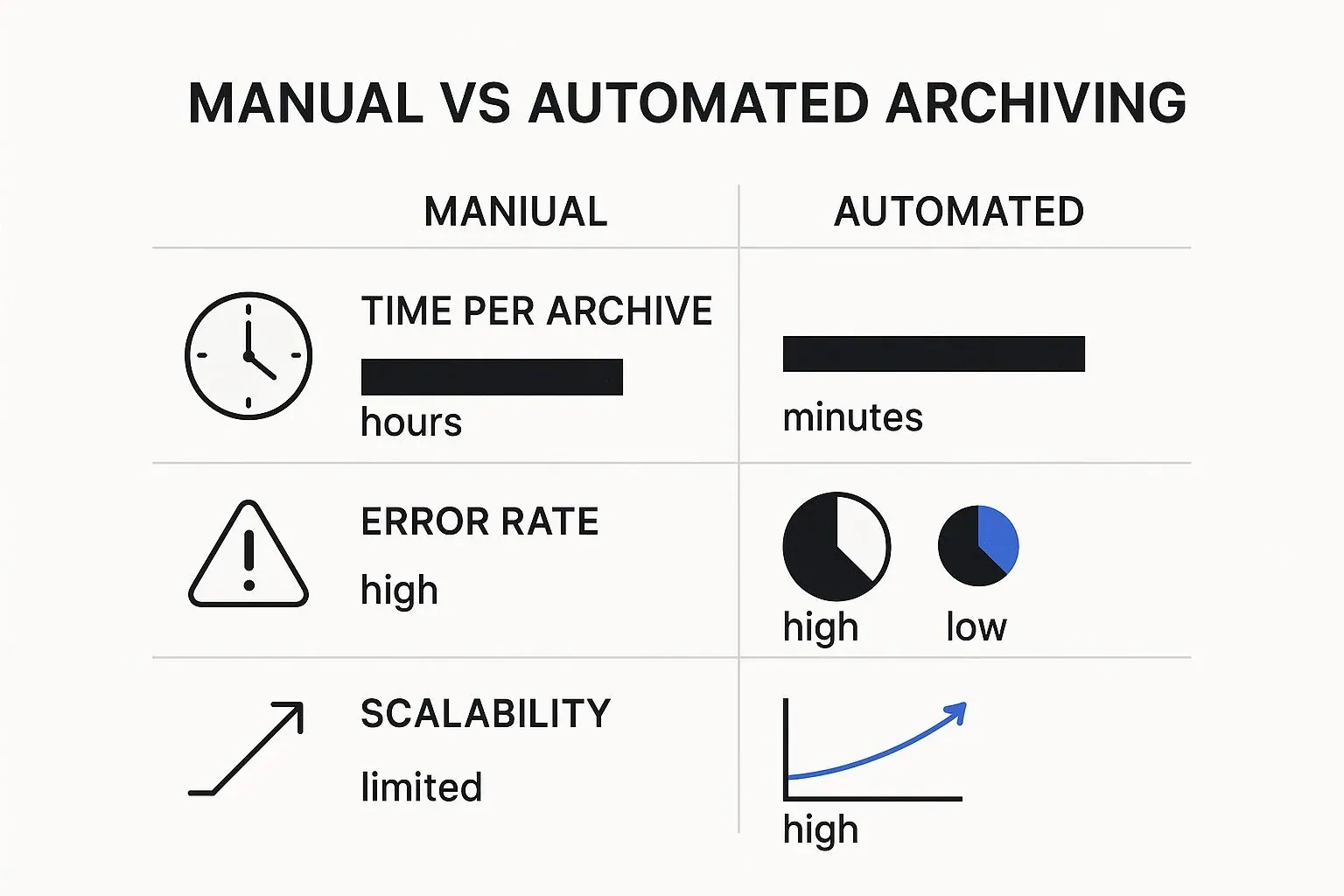
As you can see, manual archiving takes a lot of time, has a high risk of errors, and just doesn't scale well. Automated solutions, on the other hand, significantly reduce the time commitment and the chance of errors, all while offering the flexibility to handle growth. For most organizations, automation is the clear winner.
#In-House vs. Third-Party Solutions: A Balanced Perspective
Building your own in-house archiving solution might sound tempting at first. It seems like you'll have more control, right? But this approach often comes with hidden challenges. Think about the continuous costs of maintenance, regular updates, and making sure you stay compliant with ever-changing regulations. For many, a third-party solution ends up being more practical and cost-effective in the long run.
Imagine, for example, that you need to archive data from several platforms like Twitter/X, Facebook, and Instagram. Creating in-house tools to interact with each platform’s unique API and handle different data formats can quickly turn into a resource black hole. Third-party providers specialize in managing this complexity, offering ready-to-go solutions that integrate with multiple platforms. This frees up your team to focus on what they do best – running your core business.
#Evaluating True Costs and Identifying Red Flags
When you’re comparing archiving solutions, don’t just focus on the initial price. Think about things like storage fees, possible integration costs, and even the cost of training your staff to use the system properly. These hidden costs can really add up over time.
Be careful of solutions that promise a super-simple setup or unrealistic results. Properly archiving social media content takes careful planning and execution. Look for solutions with clear documentation, dependable support, and a proven track record. It's like choosing a contractor – you want someone with experience and good references.
#Reseek: AI-Powered Archiving for the Future
Platforms like Reseek represent a new approach to social media archiving. Reseek supports archiving for platforms like Twitter/X, saving your text, images, and videos. It uses a vector database to enable semantic search, powered by AI. This lets you search your archive using plain English, finding information based on meaning, not just specific words. This is incredibly valuable when you're trying to extract insights from a mountain of social media data.
For instance, imagine searching for "customer sentiment around product launch." Reseek can find relevant posts even if they don't contain those exact words. Reseek's advanced capabilities transform your archive from static storage into a dynamic, searchable resource. This empowers your organization to use its social media data to its full potential for strategic decisions, regulatory compliance, and protecting your brand.
To help you understand the different approaches to implementing social media archiving, take a look at the comparison table below:
Social Media Archiving Implementation Options: Detailed comparison of different archiving implementation approaches with costs, benefits, and ideal use cases
| Approach | Setup Complexity | Ongoing Costs | Search Capabilities | Best For |
|---|---|---|---|---|
| Manual Archiving | Low | Low (if considering only staff time) | Very Limited; manual review | Extremely small organizations with minimal social media presence |
| In-House Solution | High | High (development, maintenance, compliance) | Dependent on development resources; likely keyword-based | Organizations with significant development resources and unique compliance requirements |
| Third-Party Solution | Low to Medium | Medium (subscription fees) | Generally robust keyword search; some offer advanced features | Most organizations seeking a balance of cost, functionality, and scalability |
| AI-Powered Solution (e.g., Reseek) | Low | Medium to High (subscription fees) | Advanced semantic search, AI-driven insights | Organizations needing to extract deep insights from large datasets and prioritize efficient retrieval |
Key Insights from the Table: As you can see, the various approaches cater to different needs and budgets. While manual archiving might work for the smallest organizations, its limitations quickly become apparent as social media usage grows. In-house solutions demand significant resources and expertise. For most organizations, a third-party solution offers a good balance of cost and capability, with AI-powered solutions like Reseek taking search and analysis to the next level.
#Making Sense of Legal Requirements Without A Law Degree
Navigating the legal side of social media archiving can feel like wandering through a maze. This section breaks down these complex regulations into easy-to-understand, practical steps. We'll also explore how real organizations have successfully built compliant archiving programs, turning potential headaches into advantages.
#Industry-Specific Regulations: Practical Examples
Different industries face unique rules and regulations. Think of financial services. FINRA regulations require strict record-keeping, encompassing all social media communications. This means financial institutions need robust archiving solutions to avoid hefty penalties. Imagine a firm undergoing an audit. A well-maintained archive makes demonstrating compliance smooth and efficient, saving valuable time and resources.
For government entities, FOIA (Freedom of Information Act) requests can demand access to social media records. A clear archiving strategy ensures these requests are handled quickly and accurately. Effective social media archiving plays a crucial role in maintaining transparency and building public trust. Looking for ways to enhance your organization's overall information handling? Check out our guide on top knowledge management best practices.
#Turning Compliance into a Competitive Edge
Smart organizations don't just view compliance as a box to check—they see it as an opportunity. By building archiving programs that serve multiple purposes, they gain a competitive edge. Archived social media data can be a goldmine for understanding customer sentiment, tracking brand perception, and even identifying emerging market trends.
Picture a company facing a lawsuit related to a past marketing campaign. A comprehensive archive allows them to quickly access all relevant social media activity, providing crucial evidence for their legal team. This saves them time, money, and potential reputational damage.
#Real-World Challenges and Solutions
Compliance isn't always a walk in the park. Organizations often face challenges like constantly evolving regulations, the sheer volume of social media data, and integrating archiving with existing systems. However, by learning from others' experiences, these hurdles can be overcome.
One common challenge is the cost of storing massive amounts of data. Some organizations are using clever solutions like tiered storage, where less frequently accessed data is stored on less expensive media. This helps balance cost-effectiveness with the need for easy access to information.
Another key challenge is ensuring data integrity. A compliant archive must be tamper-proof, requiring secure storage and strict access controls. Platforms like Reseek address this by providing secure, encrypted storage and detailed audit trails, ensuring the authenticity and reliability of archived data. Reseek also supports archiving of Twitter/X posts (text, images, and videos) using a vector database, enabling powerful semantic AI search. This allows users to find information based on meaning, not just keywords, transforming how archived content is used. By understanding the legal landscape and implementing practical solutions, organizations can ensure compliance while also unlocking the strategic value of their social media data.
#Finding What Matters In Your Archive
Having millions of archived social media posts is a bit like having a massive attic filled with family photos. It's full of potential memories and stories, but without a good way to organize and search through everything, it's just a jumbled mess. Traditional keyword searches are like rummaging through boxes hoping to stumble upon the right photo. They’re not designed for the nuances of social media. Thankfully, artificial intelligence and semantic search offer a much smarter approach, transforming these unwieldy archives into truly usable resources.
#The Power of Semantic Search
Imagine you’re looking for customer feedback on new features in your product. A typical keyword search only finds posts containing those exact words. But what if your customers used different phrasing? What if they talked about “the new update” or their “experience with the latest version”? You'd miss valuable insights. Semantic search, on the other hand, grasps the underlying meaning of your search. It understands that “user experience with the latest update” and “reactions to the new interface” are related to your query, even if they don't use the specific keywords "customer feedback" or "new features."
This understanding of context is made possible by technologies like vector databases and natural language processing (NLP). Think of vector databases as creating a map of language, where words and phrases are plotted based on their relationships to one another. NLP then acts as a translator, helping computers understand and interpret human language, so they can decipher the true intent behind your search.
#Real-World Applications: From Legal to Competitive
The impact of AI-powered search is felt across many fields. In legal cases, it's like having a super-efficient paralegal who can quickly sift through mountains of social media posts to find the relevant needles in the haystack, drastically reducing manual review time. For competitive intelligence, it’s like having a team of analysts constantly monitoring competitor activity and identifying emerging trends.

This screenshot from Reseek’s website illustrates semantic search in action. Notice how the user can search using natural language, and the platform intelligently pulls relevant results based on meaning, not just keyword matches. The results truly reflect a deeper understanding of what the user is looking for.
#Reseek: Archiving and Semantic Search Combined
Platforms like Reseek are bringing these advanced search capabilities to the masses. Currently focusing on Twitter/X, Reseek archives the full post—text, images, videos—and employs a vector database for its semantic search. This means you can search your Twitter/X archive using natural language, unlocking the valuable information buried within. This combined power of comprehensive archiving and AI-powered search turns social media data from a static repository into a dynamic, searchable, and insightful resource.
#Empowering Organizations of All Sizes
In the past, these sophisticated search tools were the exclusive domain of large organizations with extensive budgets. Now, platforms like Reseek are democratizing access, making these capabilities available to businesses of all sizes. This levels the playing field, allowing smaller companies to compete more effectively. This broader access to AI-powered search elevates the value of social media archiving. Archived content is no longer just stored away—it’s a readily accessible source of valuable insights that can inform strategic decision-making.
#Building Something That Actually Works Long-Term
Creating a sustainable social media archiving program isn't about simply buying software and hoping for the best. It's about crafting a system woven into the fabric of your organization, aligned with your business goals, and flexible enough to adapt to the constantly evolving social media landscape. Think of it as building a house – a solid foundation and adaptable design are crucial for long-term success.
#Setting Smart Retention Policies
Imagine your social media archive as a well-curated museum. You wouldn't keep every ticket stub or pamphlet, would you? You'd select items of significance and historical value. Similarly, retention policies are your guidelines for what to keep, for how long, and when to let go.
These policies are not one-size-fits-all. A financial institution navigating FINRA regulations will have different needs than a local bakery. The key is to tailor your retention policies to your specific business objectives and legal requirements.
For example, a company might keep customer service interactions for two years, while marketing campaign data is preserved for five. Documenting these decisions creates a clear blueprint for managing your archive, ensuring everyone in the organization is on the same page. For more on organizing your social media content, check out this helpful guide: Social Media Bookmark Mastery.
#Managing Storage Costs Effectively
As your archive grows, storage costs can become a concern. However, there are clever ways to manage these costs without compromising functionality. Think of it like organizing your closet – you keep frequently worn items easily accessible, while seasonal clothes are stored away.
One approach is tiered storage, where frequently accessed data resides on fast servers, while less-used data is moved to more cost-effective, long-term storage. This balances accessibility with budget considerations. Regularly reviewing your archive and deleting irrelevant or outdated data is another crucial step in keeping storage costs under control.
#Empowering Your Team Through Training
The best archiving system is only as good as the people using it. Training is an investment that pays dividends in the long run. It’s like giving your team the keys to a high-performance car – they need to know how to drive it to get the most out of it.
Provide clear documentation, offer practical workshops, and foster a culture where archiving is seen as a valuable aspect of everyone's role. This empowers your team to use the archive efficiently and effectively, unlocking its full potential.
#Continuous Improvement: Adapting to Change
The social media world is constantly evolving. New platforms appear, regulations change, and your business needs shift. Your archiving program must be equally dynamic. It's like tending a garden – you need to adapt to the changing seasons and adjust your approach accordingly.
Regularly review your policies, gather feedback from your team, and stay informed about industry best practices. This ongoing process of refinement ensures your archive remains a valuable asset, not a dusty relic. Successful teams treat their archiving program as a living document, constantly adapting and improving based on their experiences and evolving needs.
Reseek not only simplifies social media archiving, capturing text, images, and videos from platforms like Twitter/X, but also uses a vector database to power semantic search. This AI-driven approach allows you to search using natural language, moving beyond rigid keywords. Imagine being able to ask your archive a question, like "What were customer reactions to our product launch last year?" and getting relevant results.
Ready to turn your social media data into a strategic advantage? Explore how Reseek can help you build a sustainable, effective, and future-proof archiving program. Visit Reseek today and discover the possibilities of intelligent archiving.